
Imagine it’s 2:00 AM. A frantic facility manager calls because a pipe has burst behind a finished wall in a high-end medical suite. To fix it, your team has to start cutting. Without accurate data, they are performing “blind surgery”—hacking through expensive finishes and structural studs just to find the source of the leak.
This is the “Ghost of Construction Past,” and it’s an expensive spirit to exorcise.
In the modern building landscape, “as-built” documentation shouldn’t be a folder of blurry iPhone photos. To truly protect your margins and your reputation, you need a Digital Twin that gives you the X-Ray Advantage.
The Blind Spot in Modern Construction
Most builders document their progress, but few do it systematically. Traditional photography has three fatal flaws:
- The Gap: You only take photos of what you think is important at the time.
- The Context: A photo of a manifold is useless if you can’t tell exactly where it sits in relation to the north-facing window three years later.
- The Metadata: Random JPEGs lack the spatial coordinates needed for precise “surgical” repairs.
The result? When a wire shorts or a valve fails, you aren’t just paying for the repair—you’re paying for the investigation, the extra demolition, and the massive rework.
What’s Behind Your Drywall?
The power of a Digital Twin (Reality Capture) is best understood through a simple visual.
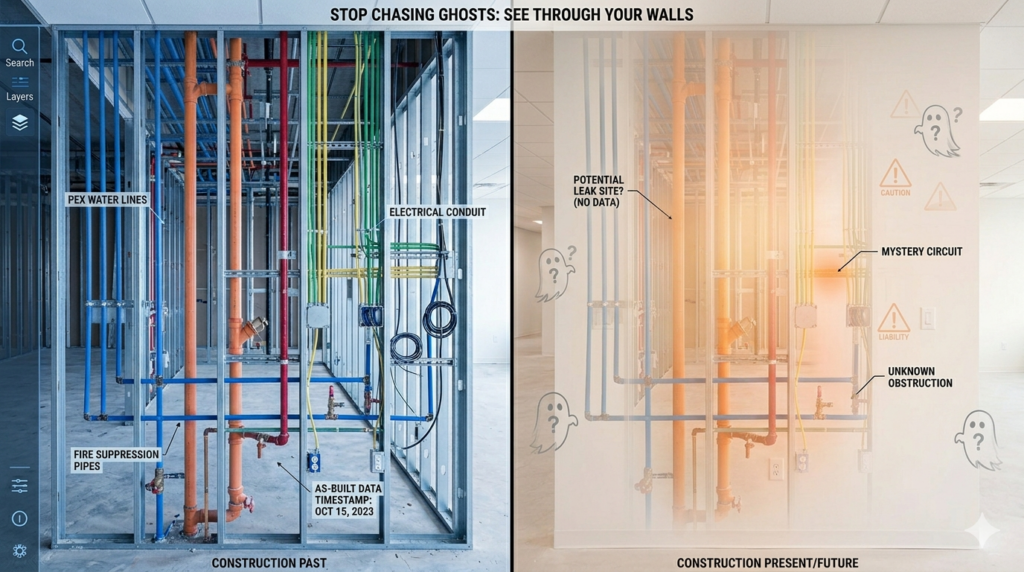
By using reality capture before the walls are closed, you create a permanent, 360-degree record. You are essentially giving future owners and maintenance teams X-ray vision.
3 Ways a Digital Twin Acts as Insurance
1. Subrogation Defense and Liability
When a claim arises, the first question is always: Who is at fault? Reality capture provides an immutable, time-stamped record of the “Golden Hour”—the moment before the walls were closed. It proves that the flashing was installed correctly, the wiring was to code, and the insulation was present. It’s the “Black Box” for your building.
2. Surgical Maintenance
Why demolish an entire hallway to find a leak? With a Digital Twin, you can overlay your “Before” capture onto the current wall using a tablet or AR headset.
- Old Way: $5,000 in investigative demolition and $10,000 in drywall/paint rework.
- The X-Ray Way: One 12-inch square cut, exactly where the valve sits.
3. Claims Acceleration
Insurance adjusters thrive on data. A claim backed by a high-resolution point cloud or a 360-degree walkthrough is processed significantly faster than one backed by hearsay and “after-the-fact” photos. It removes the “maybe” from the conversation.
The ROI of “Knowing” vs. “Guessing”
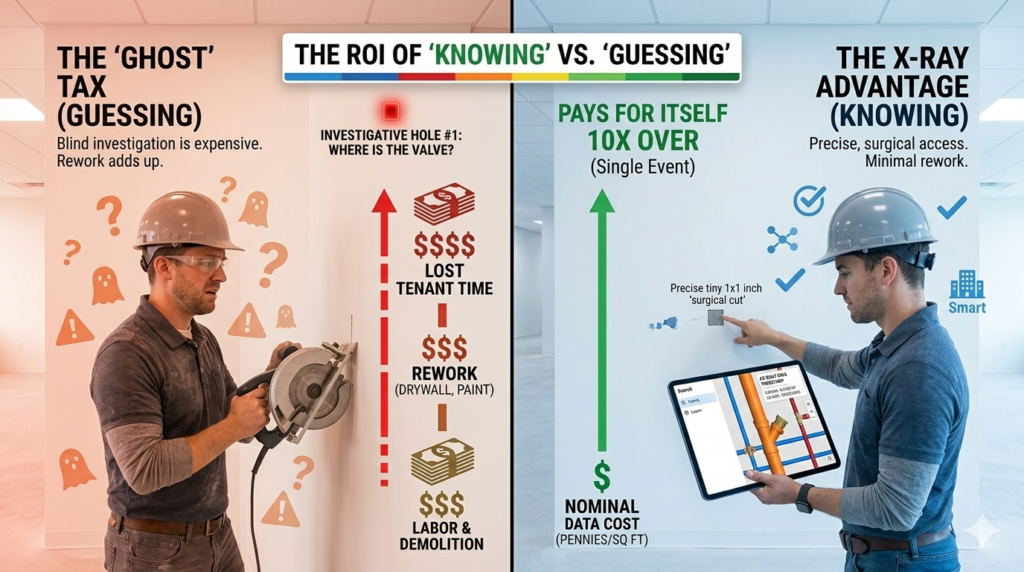
The math behind reality capture is simple. If you can avoid even one instance of major rework or a single litigated claim, the technology pays for itself ten times over.
Consider the cost-benefit of a single investigative hole:
- Cost of Digital Capture: Nominal (pennies per square foot).
- Cost of “Blind” Investigation: Thousands in labor, materials, and lost tenant time.
Don’t Let Your Pipes Become a Mystery
The walls are closing in—literally. Once the drywall goes up, the opportunity to capture the “truth” of your building vanishes.
Reality capture isn’t just a fancy way to look at a job site; it is the ultimate insurance policy. It ensures that the Ghost of Construction Past stays in the past, and your building remains an open book for those who have to maintain it.
Ready to see through your walls? CONTACT US TODAY!