
In commercial construction and adaptive reuse, few phrases make a Project Manager wince quite like “field modification required.”
Whether it is a heavy HVAC main duct striking a newly placed structural beam or a plumbing stack misaligned with an overhead sleeve, MEP (Mechanical, Electrical, and Plumbing) conflicts are among the leading drivers of budget overruns in commercial projects. According to industry data from the Construction Industry Institute (CII), direct rework typically consumes 5% to 10% of total construction costs—a massive hit to already tight margins.
The frustrating reality? Most of these field collisions occur not because of poor engineering design, but because engineering models were built on outdated, incomplete, or inaccurate drawings.
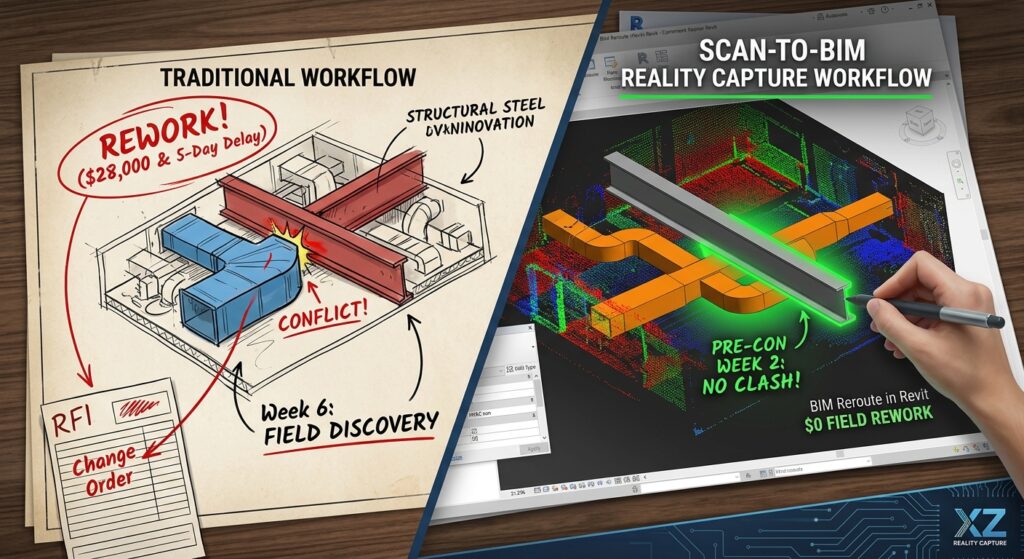
Pre-construction reality capture changes this equation entirely. By generating millimeter-accurate 3D point cloud models of existing site conditions before fabrication begins, site teams can identify and resolve spatial clashes digitally rather than on the job site floor.
The Anatomy of an MEP Clash: How Small Discrepancies Compound
Consider a standard commercial renovation. Legacy CAD drawings might show a clear ceiling plenum depth of 24 inches. Based on those historical sheets, your BIM team routes main supply ductwork, sprinkler lines, and conduit racks with tight clearances.
However, over decades of past tenant improvements, structural settling, or unrecorded modifications, the actual clearance on-site may only be 19 inches.
What Happens Without Reality Capture:
- The Discovery: The mechanical subcontractor attempts to install pre-fabricated ductwork on-site and physically cannot fit the run.
- The RFI Delay: Work on that floor grinds to a halt while an Request for Information (RFI) is filed, routed, and reviewed by structural and design teams.
- The Financial Ripple Effect:
- Pre-fabricated ductwork must be scrapped or cut down on-site.
- Electrical and plumbing trades are displaced, leading to cascading schedule shifts.
- A formal Change Order is generated to re-route systems through adjacent bays.
In a single ceiling plenum, a single undetected spatial clash can easily generate $15,000 to $40,000 in direct change orders and days of lost momentum.
Case Study in Value: Catching the Overhead Clearance Mismatch
To understand the financial return on reality capture, let’s look at a typical scenario from an adaptive reuse medical office renovation:
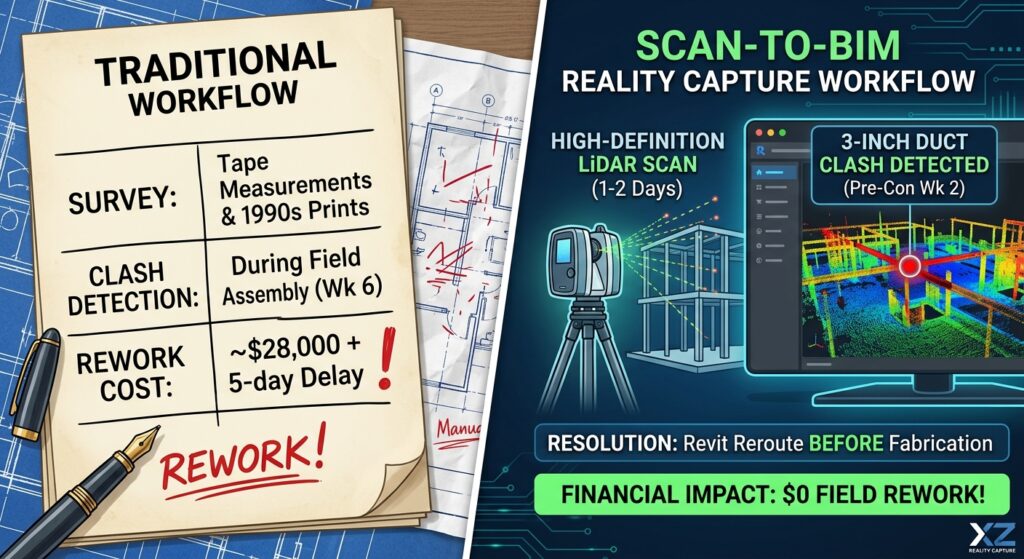
By identifying the overhead clearance conflict inside the digital model, the cost to fix the issue was limited to 30 minutes of a BIM coordinator’s time—rather than thousands in wasted fabrication and field labor.
3 Ways 3D Laser Scanning Safeguards Your Project Budget
1. Eliminating “As-Built” Uncertainty
Traditional 2D blueprints rarely capture the true state of an existing building. Structural deflections, sagging joists, non-plumb walls, and previous undocumented mechanical runs remain invisible until walls are opened up. A 3D laser scan captures millions of data points per second, revealing reality exactly as it exists.
2. Streamlining Off-Site Pre-Fabrication
Pre-fabrication speeds up project delivery, but it leaves zero margin for error. If pre-assembled pipe racks or modular MEP skid units don’t fit the field anchors, the efficiency gains evaporate instantly. Point cloud data provides total confidence that pre-fabricated components will drop into place smoothly.
3. Faster Trade Coordination
Instead of trade contractors arguing over spatial priority on-site, a federated BIM model aligned with reality capture data allows teams to negotiate ceiling rights and routing paths collaboratively before setting foot on site.
The Bottom Line: Reality Capture is Project Insurance
3D laser scanning should not be viewed as an added line-item expense—it is high-value project insurance. On almost every renovation or complex commercial project, the cost of a pre-construction reality capture survey is fully offset by the very first major change order it prevents.
When you eliminate guesswork before ground is broken or demolition starts, your schedule stays intact, your sub-trades stay productive, and your profit margins remain protected.